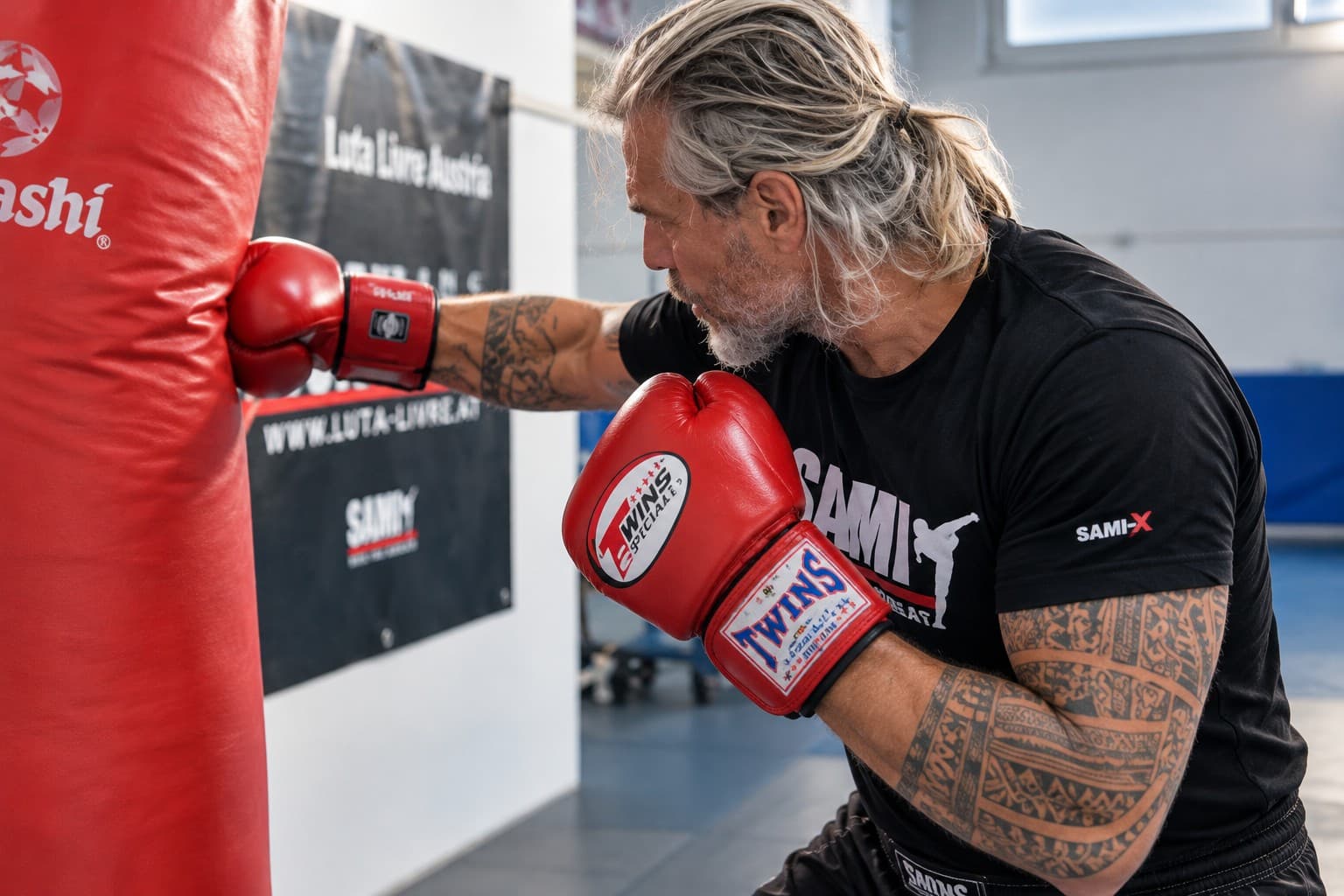

You want to learn boxing techniques, improve your fitness and enjoy varied training without taking punches? You do not need sparring or a partner for every session. Shadowboxing, footwork, punching bag training and interactive Virtual Feeding give you several ways to structure your training on SAMI-X.
What matters is how you use the content. Watching a video is a start. Progress comes from practicing the movement, training regularly and connecting familiar techniques with new tasks.
You do not need prior experience, and you do not have to get fit before you begin. Start with the fundamentals and adjust the amount of training and the pace to your current level.
Do you need sparring to train boxing?
In sparring, two people box together and react to each other. Depending on the task and intensity, punches may land. However, sparring is not essential for many other training goals.
You can learn punching techniques, improve your conditioning and work on balance and coordination without fighting someone. Punch training can be a standalone form of technique and fitness training.
On SAMI-X, you can connect technical content with practical training sessions. Deliberate learning, repeated movement tasks and physically demanding rounds each serve different purposes.
When starting out:
- Begin with clear, fundamental tasks.
- Develop controlled movements before adding speed.
- Distinguish technique practice from physical conditioning.
What you can learn without sparring

A stable stance and an appropriate guard are the starting point. Individual punches, returning your hands to their starting position and connecting punches with footwork build on these foundations.
Even a jab involves several tasks: moving the arm in a controlled way, keeping the other hand in an appropriate position and staying balanced. Adding a step requires your legs and arms to work together.
Do not use the technique videos only to memorize punch sequences. Notice how each movement starts and ends. Can you move again afterwards? Are you stable? Do your hands return to your guard?
Three fundamentals run through your training:
- Stance and guard: Find a position from which you can punch and move.
- Punching technique: Work with control and return your hands to your guard.
- Footwork: Connect punches with movement and remain stable afterwards.
What punch training offers as fitness training
Your arms, legs and trunk work together during punch training. You change position, shift your weight and repeat punches and steps over several rounds.
This can improve your endurance and your ability to sustain repeated physical effort. The demands of a session depend on its duration, intensity, rest periods and how regularly you train.
You do not have to perform every round at maximum speed. If fatigue makes your punches uncontrolled, the quality of technical learning suffers. Adjust the workload so you can still carry out the task deliberately.
Punch training also challenges your muscles, but it does not fully replace targeted strength training. The two forms of training can complement each other.
For your online training, this means:
- Technique rounds: Work slowly and attentively on a movement.
- Conditioning rounds: Repeat familiar sequences for an appropriate duration.
- Rest periods: Recover enough to continue with control.
Which abilities you develop

Punch training requires more than fast hands. You need to coordinate movements, control your position and respond to tasks.
Coordination: Your legs, trunk and arms work together. Start with individual movements and connect them gradually, for example a jab with a forward and backward step.
Balance: Steps and punches involve weight shifts. You practice staying stable and returning to a suitable position after moving.
Rhythm and timing: You learn to coordinate punches and steps in time. Feeding adds the task of responding to an external cue.
Body awareness: You increasingly notice when you tense your shoulders unnecessarily, lean too far forward or stand in an unsuitable position.
Concentration: Understanding a task and carrying it out deliberately while physically working are also part of training.
These abilities develop through appropriate exercises and repetition. Punching into the air as fast as possible is not enough on its own.
Shadowboxing: Solo training without equipment

Shadowboxing requires neither a partner nor a punching bag. You can practice stance, guard, punching technique and footwork separately before connecting them.
Give each round a focus. Instead of stringing together random combinations, practice a jab with a step and then move back with control. In another round, connect two punches you already know.
On SAMI-X, you can watch the relevant sequence, pause the video and rehearse the movement at your own pace.
Pay attention to:
- Enough space for your steps and punches.
- Controlled movements without forcefully locking out your joints.
- Balance and returning to your guard.
Punching bag training: Adding contact

If you have access to a punching bag, you can connect familiar techniques with a target. You feel the contact and can check whether your distance is appropriate.
One round can focus on individual straight punches, another on combinations followed by movement. Increase the workload only once you can perform these tasks with control.
The bag provides resistance, but it does not correct mistakes. A punch that sounds powerful tells you little about whether your stance and movement are appropriate.
Three priorities help:
- Distance: Reach the target without leaning forward uncontrollably.
- Position: Stay stable after a combination and remain able to move.
- Intensity: Maintain your technique as the workload increases.
Virtual Feeding: Working with a virtual training partner
In interactive Virtual Feeding, the person on screen gives you a visible cue. Depending on the task, you respond with a familiar punch combination, a defensive movement or appropriate footwork.
Unlike free shadowboxing, you do not decide every moment yourself. You need to perceive what is shown and time your response accordingly.
Feeding adds awareness, reaction and a defined task to your solo training.
Learn the required movement separately first. Trying to understand a cue while also performing a completely new technique can make the task unnecessarily difficult.
Use Feeding gradually:
- Choose a manageable task with familiar movements.
- Begin at a pace where you can clearly recognize the cue.
- Increase the difficulty only when your response remains controlled.
Virtual Feeding represents a real partner only partially. Actual reach, physical contact and another person's spontaneous adjustments cannot be fully trained through a screen.
Turn the content into a training session
You do not need a long list of videos to begin. Choose one focus and use it across different forms of training.
Example: Jab and cross with footwork
- Prepare: Move easily and begin with simple steps and gentle punching movements.
- Watch: Study the technique and notice stance, punch path and the return to guard.
- Rehearse: Practice slowly at first, without time pressure.
- Repeat: Connect the familiar punches with suitable steps during shadowboxing.
- Apply: Use a Feeding task that matches the movements you have practiced. If available, add controlled punching bag training.
- Review: What is already working? Where do you lose balance or control?
For example, begin with short practice rounds of one minute and sufficient rest. This is a starting suggestion, not a fixed requirement. Adjust the duration to your concentration and capacity.
Boxing workouts and training plans for regular practice
SAMI-X also offers many boxing workouts that you can use alongside technique practice. They allow you to repeat familiar punching techniques, challenge yourself physically and add variety to your solo training.
The training plans help you connect the content in a meaningful way. You do not have to build every session yourself; you can follow a structured sequence. Adjust the pace, workload and rest periods to your current level.
You can combine the options as follows:
- Technique videos: Understand individual movements and improve them deliberately.
- Boxing workouts: Practice familiar techniques in a complete session.
- Virtual Feeding: Respond to visible cues and apply suitable movements.
- Training plans: Give your training structure and work regularly on your priorities.
Use a boxing workout as a standalone session or as an addition to technique practice. If a movement is still new, practice it calmly first. Physically demanding rounds are best based on sequences you can already perform with control.

Boxing Level 1 – Fundamentals: Peter Weckauf’s original training overview (German).
Can you start later in life?

You can begin boxing and punch training in your 40s, 50s, 60s or later. What matters is your current physical condition and an appropriate progression.
Online training allows you to watch content repeatedly and practice at your own pace. Use that opportunity instead of immediately trying to match the speed of the demonstration.
When starting out:
- Learn the fundamentals without rushing.
- Increase the workload and intensity gradually.
- Measure progress against your own development.
What online training can offer
On SAMI-X, you can learn technical sequences, repeat familiar movements and structure your solo practice. Shadowboxing, the punching bag and Virtual Feeding offer different tasks for technique and fitness.
However, a video does not provide immediate correction of your execution. If you cannot confidently understand a movement or make progress despite repeated practice, feedback from a qualified trainer can help.
Good performance in Feeding also does not automatically mean you can act effectively in a physical confrontation. Nevertheless, these training methods can make a valuable contribution to learning boxing techniques and improving your fitness.
Your next step on SAMI-X
Choose one familiar technique or combination for your next session. Watch it attentively, rehearse it slowly and then use it in shadowboxing or an appropriate Feeding task.
You do not have to work through as much content as possible at once. Stay with one focus until you understand the movement better and can perform it with greater control. Use the boxing workouts and training plans to turn that practice into a regular routine.
Turn watching into regular punch training: understand, practice, apply and develop with purpose.
More of this by email
New techniques, courses and articles in the SAMI-X newsletter.
Related Articles
Make Martial Arts Training a Habit: How to Stay Consistent with SAMI-X
Build a training routine that fits your life: use small goals, technique videos, guided workouts and useful feedback to practice consistently with SAMI-X.

Boxing or Krav Maga? An Honest Comparison After 26+ Years of Practice
Boxing or Krav Maga? After 26+ years coaching both, I honestly compare their strengths, limits and goals – and explain why the best answer is often the combination.