
Someone comes uncomfortably close. You step back, and they follow. No strike has been thrown, but you can feel that something is wrong. Self-defense begins at this point. Recognizing distance, communicating boundaries and maintaining freedom of movement are essential foundations.
Many people first associate self-defense with defensive techniques. Yet your position before a possible attack already influences your options. Can you still move? Can you see the other person's hands? Is there a way to leave the situation?
Distance is therefore more than the space between two people. It influences what you can perceive, how quickly physical contact can occur and which options remain available.
What more than 25 years of teaching have taught me
From my experience of more than 25 years teaching self-defense, understanding distance is one of the foundations we must teach from the beginning. A technique cannot be considered independently of where we stand, how the other person moves and how much space we have.
This relationship also plays an important role in my work with authorities and operational personnel. Close proximity cannot always be avoided in that context. Communication, assessment and readiness for physical action must work together. Some duties also involve situations that cannot simply be left.
These professional requirements differ from those of a private individual. However, the same principle applies to both: noticing changes in distance early helps you adjust your position and behavior more deliberately.
That is why distance training has a permanent place in sound self-defense education.
Personal space and physical reach
Not everyone standing close to you poses a threat. On public transport, at events or in a queue, close proximity can be difficult to avoid.
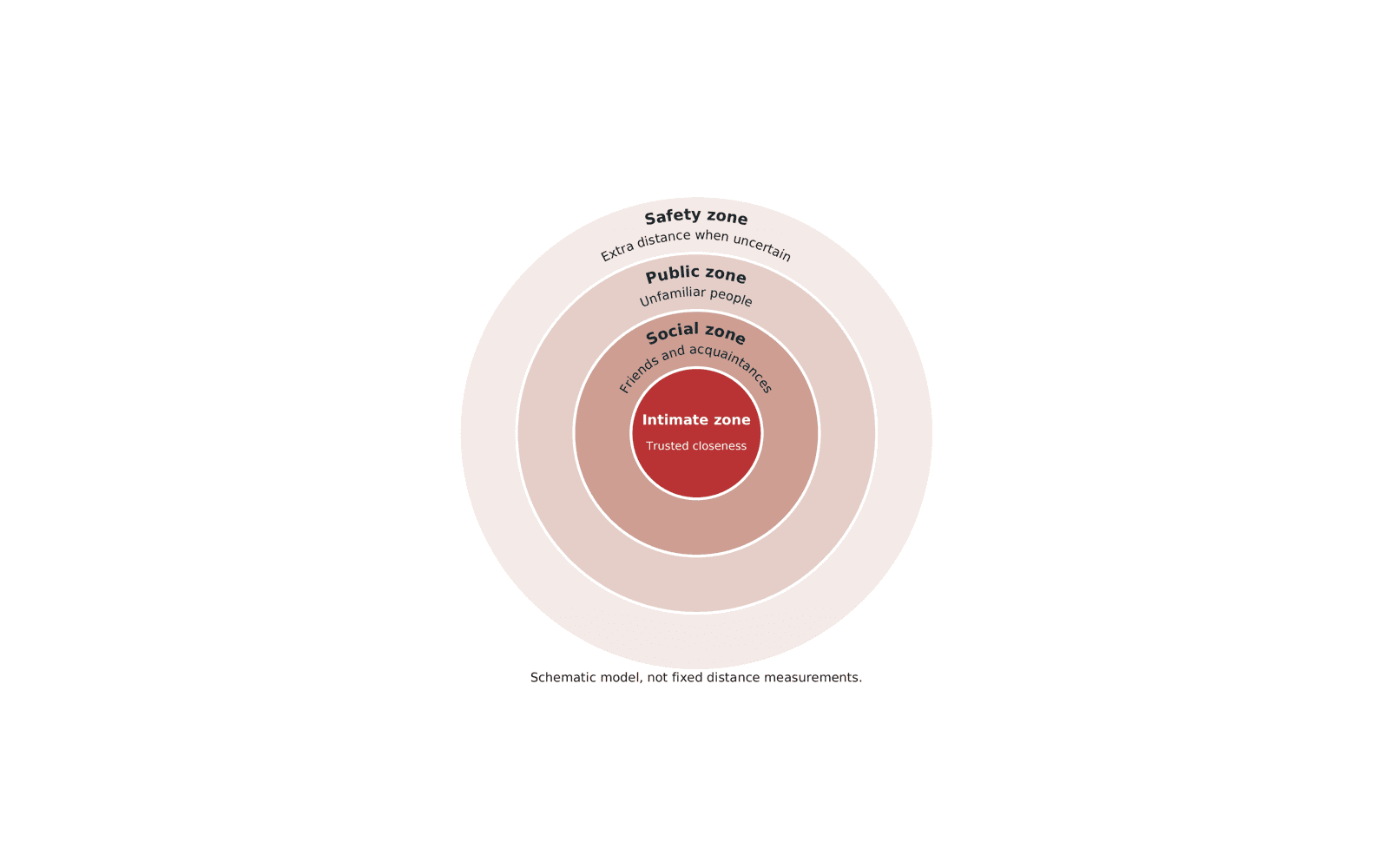
Nevertheless, we have personal boundaries. How much distance feels comfortable depends on familiarity, the situation and individual needs. Our model distinguishes four relationship zones:

This classification describes how we feel. It does not yet tell us whether someone can physically reach us. A person can appear friendly while already standing within striking range. Conversely, someone may raise their voice while you still have distance and a clear exit.
For self-defense, both your sense of personal boundaries and actual physical reach matter.
Why distance matters
Someone standing directly in front of you may be able to reach you without taking another step. From farther away, they first have to cover some ground. This may give you more opportunity to notice a movement and act.
Distance alone does not resolve the situation. If you back into a wall or trip over an obstacle, you lose freedom of movement. Even a substantial initial distance can disappear quickly when someone approaches fast.
Assess distance consciously
- Observe the whole situation. Include hands, movement, surroundings and other people.
- Consider your room to move. Look for a usable route to leave the situation.
- Respond to changes. A distance that was sufficient a moment ago may become too short in the next instant.
The six distance ranges
At SAMI, we use six distance ranges to explain different training requirements. They overlap and transition into one another.

The distance ranges are guides, not fixed safety boundaries. Reach changes with movement, body size and the objects involved.
The distance ranges in detail
1. Weapon range
An object can change the reach and danger of an attack. The distance depends on the object, movement and surroundings. There is therefore no universal distance that guarantees safety.
The priorities are recognizing danger early, maintaining distance, using suitable barriers and finding a way to leave. Simply closing the distance is not a general solution.
2. Kicking range
Within this range, a person can reach you with their leg. You may therefore be outside the immediate reach of their hands and still be within reach.
In training, you learn to assess reach more accurately and recognize an approach. A fixed measurement is of little use because body size, technique and movement vary.
3. Striking range
Hands and arms can reach you directly here. An ordinary conversation may already take place at this distance.
Training therefore also includes positioning, an appropriate hand position and clear communication. You want to avoid unnecessary provocation while remaining prepared.
4. Close range
At very short distances, compact movements and close physical contact become possible. Your view may be restricted, and there is often too little room for larger evasive movements.
That is why we also train at this distance: in a controlled way, with clear tasks and a gradual progression.
5. Clinch and throwing range
This involves close contact through gripping, holding or pushing. Balance, body position and sensing pulling and pushing movements become more important.
For private individuals, the goal remains to regain options and leave the situation whenever possible. The professional duties of operational personnel may involve additional requirements.
6. Ground range
On the ground, mobility and your view of the situation change considerably. Getting up may be difficult. Other people or objects can make the situation more dangerous.
We therefore also practice ground fundamentals. These include orientation, protection and regaining a position from which you can move away.
Transitions: Moving between distance ranges
A confrontation rarely stays at a single distance. Someone may initially stand outside reach, approach and then grab. Striking range can become close physical contact, and a standing situation can move to the ground.
We call these changes transitions. They change the requirements: something that worked a moment ago may lose its effect with one step or one grip.
From my teaching experience, it makes little sense to train the distance ranges only in isolation. Individual tasks help with learning. We then need to connect them and practice recognizing and responding to changes.
This involves more than switching from one technique to another. You need to adapt your position, balance, perception and actions.
The six distance ranges explain the situation. Transitions connect them with movement and change.
Self-defense begins in the mind
Distance zones begin as theory. In a real situation, there are no circles marked on the floor. People move, distances change and you have to make decisions.
Nevertheless, this theory needs a permanent place in practical self-defense training. It helps you understand what to pay attention to. Controlled partner training then allows you to experience these relationships.
Self-defense begins in the mind: perceive, assess a situation, make a decision and act. This includes being willing to communicate a boundary or leave a situation early.
At SAMI, we therefore combine technical content with awareness, a sense of distance and decision-making. A defensive technique alone does not cover these abilities.
What you can consciously practice every day

You do not need a training partner for this. In everyday life, briefly and deliberately focus your attention on your surroundings:
Orientation: Where is an exit? Where can you move freely? Distance: How much proximity feels comfortable? When would you like to change your position? Boundaries: State a legitimate concern clearly instead of withdrawing it because you feel uncertain.
You do not have to constantly look for danger. You are practicing greater awareness of your surroundings and your own needs. These habits complement practical training; they do not replace it.
Practice distance consciously in online training
On SAMI-X, you can watch the demonstrated sequences repeatedly and examine individual movements more closely. Use this opportunity to understand not only the technique, but also the starting position, distance and changes during the sequence.
First watch a sequence all the way through. Then watch it again with a specific question: At what distance does the task begin, and what changes the distance? Also pay attention to the feet, body alignment and position relative to the training partner.
How to practice on your own
- Observe: Choose a familiar sequence and identify the starting position and changes in distance.
- Rehearse slowly: Practice suitable steps and positions without a partner. Allow enough space and begin without speed or additional pressure.
- Check consciously: Are you balanced? Can you keep moving? Do you understand why the position changes?
- Repeat: Work on one focus first. Watch the sequence again and compare your movement with the demonstration.
Online training can help you prepare movements and deepen your understanding. Whether distance, timing and reactions work with another person becomes clear through training together.
From video to partner training
If you have a suitable training partner, you can rehearse familiar tasks in a controlled way. Agree beforehand on what you will practice, how slowly you will begin and when you will stop. Change only one condition initially, such as the starting distance.
Observe together: When is distance closed? When does reach change? When must your own position be adjusted? Different body sizes show why a distance seen in a video cannot be applied unchanged to every person.
With contact, grips or pushing movements, feedback and gradual progression are particularly important. More demanding content, such as throws, ground work or tasks with training weapons, requires an appropriate setting and qualified instruction.
Understanding transitions online
Use repeated viewing to recognize the moment of a transition. A longer distance becomes striking range, proximity becomes physical contact, or pulling and pushing change a position. What matters is the new requirement created by that change.
Practice suitable steps and position changes individually first. Connect familiar sequences only once you can perform them in a controlled way. A video supports understanding, but does not give you immediate feedback on your own execution.
For your next session: one sequence, one focus and deliberate repetitions. Observe the distance and check how your position responds.
If you cannot confidently understand or perform a task, seek feedback from a qualified trainer. Online training complements practical instruction and helps you keep learning purposefully between shared sessions.
A sense of distance belongs in self-defense
In your training, you learn to assess reach, notice changes and choose your position more deliberately. This requires repetition, different training partners and tasks that gradually become more demanding.
After more than 25 years of teaching, I am clear about this: awareness, boundaries, distance and decisions must be part of self-defense training. They belong alongside physical fundamentals and defensive techniques.
More of this by email
New techniques, courses and articles in the SAMI-X newsletter.
Related Articles
Make Martial Arts Training a Habit: How to Stay Consistent with SAMI-X
Build a training routine that fits your life: use small goals, technique videos, guided workouts and useful feedback to practice consistently with SAMI-X.

Boxing or Krav Maga? An Honest Comparison After 26+ Years of Practice
Boxing or Krav Maga? After 26+ years coaching both, I honestly compare their strengths, limits and goals – and explain why the best answer is often the combination.

Focus Pad Training – The Art of Proper Pad Holding in the SAMI-X System
A comprehensive guide to focus pad training in the SAMI-X system. Learn proper pad holding techniques, feeding methods, striking combinations, and how structured pad work elevates your training from technique to real-world application.